STACE Farm Blog
Prepared by Pipeline Worldwide for E3 Africa · October 16, 2026
For reviewers: This story is written in E3 Africa's voice for current supporters and prospective donors. Please check names, facts, quotes and photo captions. Edits with Track Changes or comments are welcome. Quotes are lightly edited from interview transcripts for grammar; meaning is unchanged.
Planting Hope: How the STACE Farm Feeds Students and Grows Futures
Good soil. Hard work. A future that lasts.
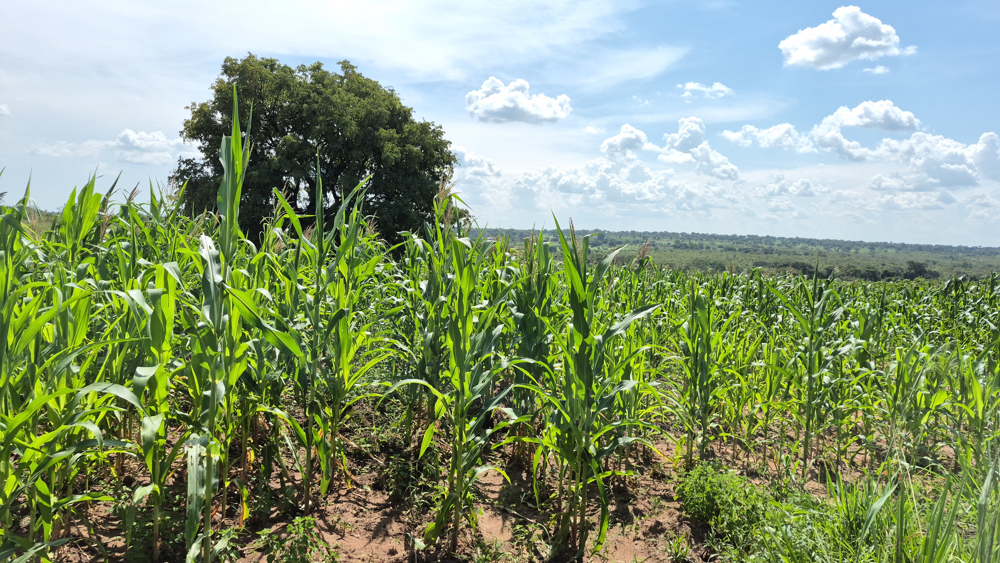 Maize growing at the STACE Demonstration Farm in Erepi, Moyo District.
At St. Thomas Aquinas College Erepi (STACE), the school day doesn't end at the classroom door. It continues in the fields.
On the STACE Farm, rows of maize stretch toward the horizon. Here, students learn to plant, tend, and harvest. And many of the meals they share at school begin here, too.
In Uganda, feeding students is the single biggest cost of running a school. It takes more than 40 percent of the budget, says Joseph Ambayo, executive director of EENU/E3 Africa, Uganda. For families in Moyo District, who are among the poorest in the country, that cost can decide whether a child stays in school. The farm helps close that gap, so STACE can keep its tuition the lowest in the region while ranking first in the West Nile Region.
A mother's dream, a son's promise
Every harvest at STACE traces back to one woman's gratitude.
About 20 years ago, after two close calls in her family, Rosalie Weller wanted to give thanks in a way that would last. Her husband suggested helping “the kids in Africa.” Soon after, she met Father Robert Seraph Aliunzi, and at 70 years old, she co-founded E3 Africa alongside him.
Rosalie grew up on a farm. She knew what good soil and hard work can do. Shortly before she passed away in 2021, at age 89, she turned to her son Joe with one last request: “Joe, we've talked about a farm at the board meeting for years. See if you can make it happen.”
Joe did. The Weller family raised the funds, and partners in Uganda purchased the land.
Rosalie never traveled to Uganda. “She saw it through my eyes, she saw it through Joseph's eyes, she saw it through Father Robert's eyes,” Joe says. Today, her dream helps feed hundreds of students every day.
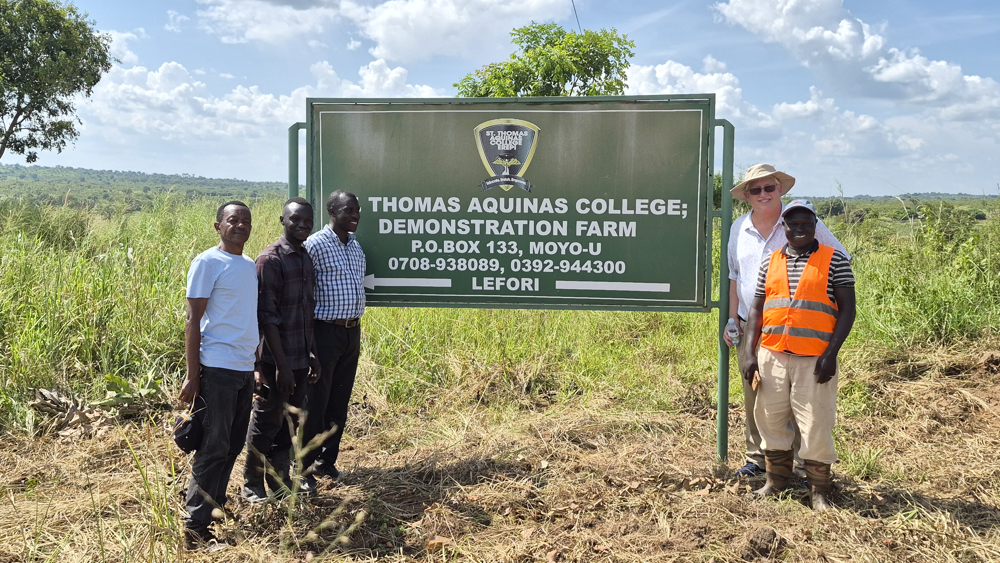 Joe Weller (back right) with STACE staff at the entrance to the St. Thomas Aquinas College Demonstration Farm.
Teach a student to fish
From the start, STACE has been shaped by a proverb Father Robert holds dear: Give a man a fish, and he eats for a day. Teach a man to fish, and he eats for a lifetime.
“Students have been taught how to work hard at academics, how to work hard on the farm, how to work hard in all spheres of life, so that they are able to be self-sustaining,” says Joseph Ambayo.
Father Robert also envisioned a school that builds peace. Students and teachers come from across Uganda and from many tribes. “All the kids interact as one family,” Joe says.
The farm carries that vision forward in three ways:
- Nourishing students. More than 800 students count on the school for daily meals. The farm's maize harvest has grown from 14 tons in its first year to 26, then 50. This year, the goal is 109 tons.
- Growing skills. Students learn to plant maize, cassava and sweet potatoes, then carry that knowledge home over school holidays. Last year, more than 500 students took part in farm internships and projects; some earning $30 to $40 toward their education.
- Strengthening the community. Neighbors find work on the farm and bring income home to their families. And knowledge spreads. When students learn something new, Joe says, “they take it back to their village, and their friends see what they're doing, and they copy it.”
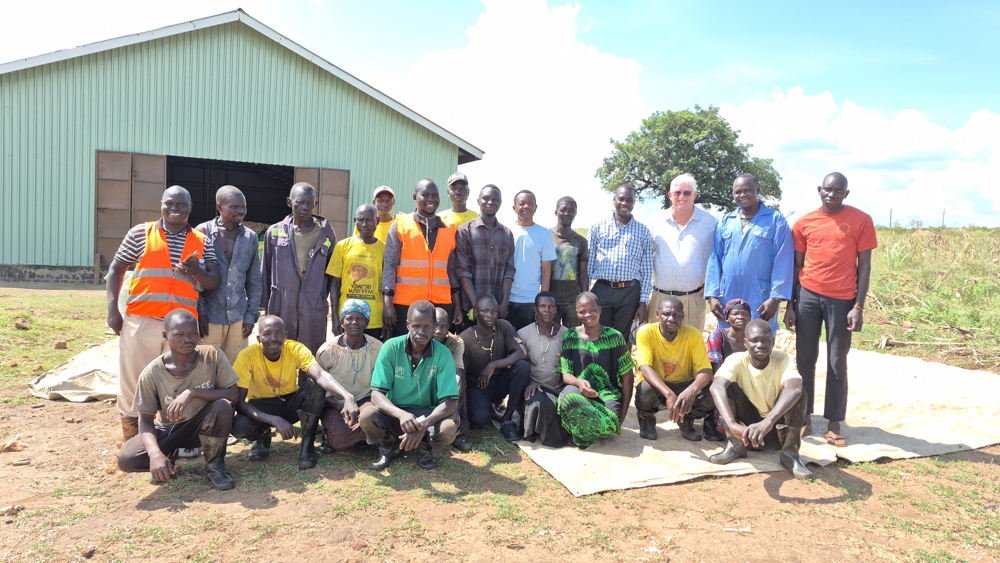 Farm workers and staff gather with Joe Weller outside the farm's storage barn.
Built by many hands
The farm has grown one gift at a time. Friends of the Weller family gave $10,000 to build the first structure on the land, back “when it was nothing.” Others funded a bulldozer. Longtime partner Pipeline Worldwide drilled STACE's first well, then added a motorized pump, solar panels, medical equipment and training for the farm's first staff.
“Without the well, we would not have St. Thomas Aquinas constructed,” Joseph says.
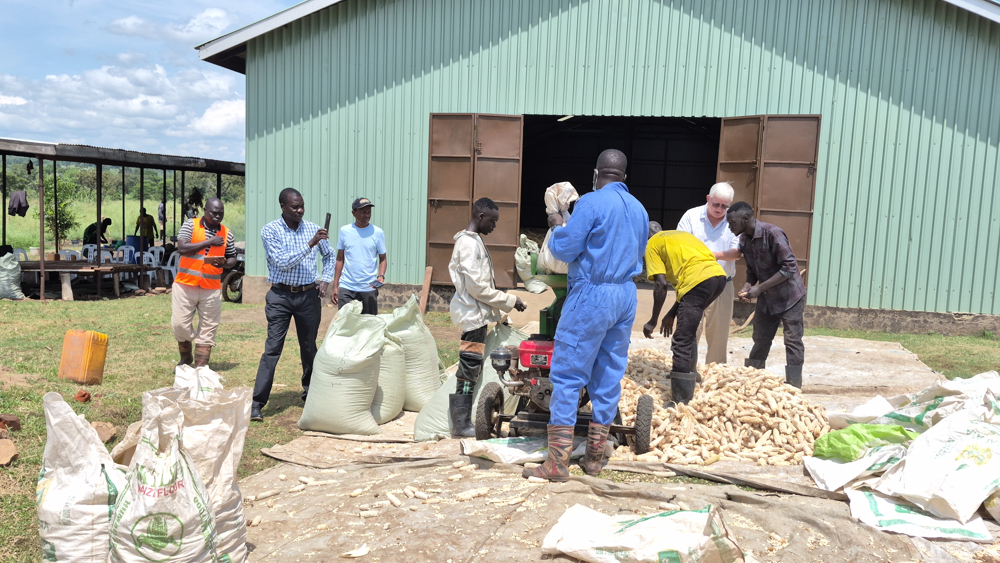 Joe Weller (in white) checks in as farm staff shell this season's maize.
A promise kept
For Joe, the farm is personal. He has served E3 Africa for more than 20 years, first as his mother's sounding board, then as board secretary and chairman. Today he serves as a permanent member at large, filling the seat she left behind.
The Weller family considers E3 Africa its most important charitable work. “It works because we can see it,” Joe says. Ideas sometimes come to him in the middle of the night, and he sends them straight to Joseph.
“When I was very young, I envisioned that when I'm 80 years old, I want to look back on my life and see that I've done some good things,” Joe says. “This is one of the spots in the world where I can make a big impact.”
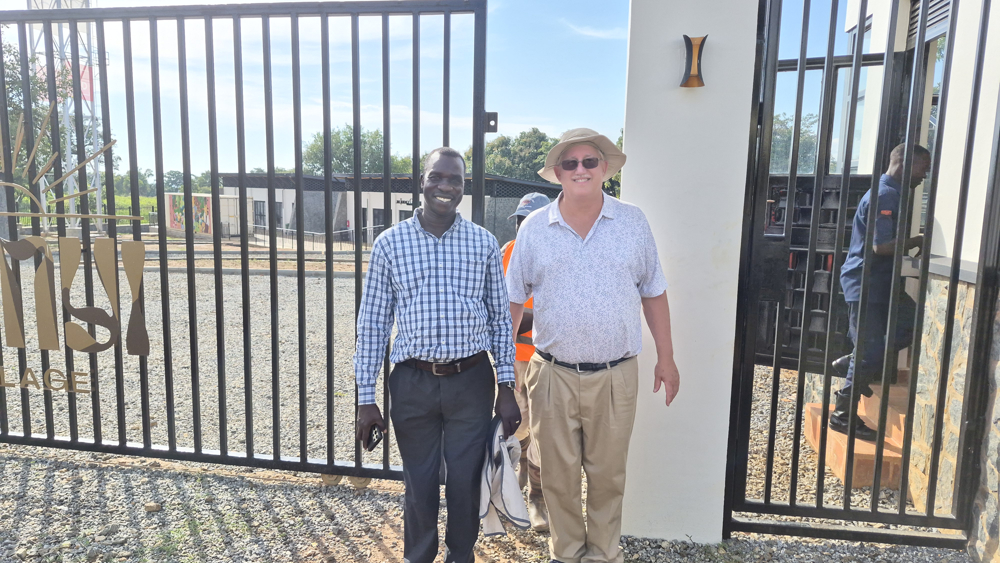 Joseph Ambayo (left) and Joe Weller at the Lonyi Village gate in Moyo.
What's next for the farm
Joe and Joseph are shaping a three-to-five-year plan for the farm. They picture a hillside orchard, a barn with equipment to dry and preserve each harvest, and beans and vegetables growing alongside the maize. Any surplus would be sold to help keep tuition low. Further ahead, there may be irrigation, fishponds, and cattle.
Two needs stand out right now:
- A shelter on the farm. The farm sits about 10 miles from campus, and when the rain comes, students have nowhere to keep learning.
- A dairy cow. Fresh milk would give students a more balanced diet, providing “A healthy mind in a healthy body,” Joseph says.
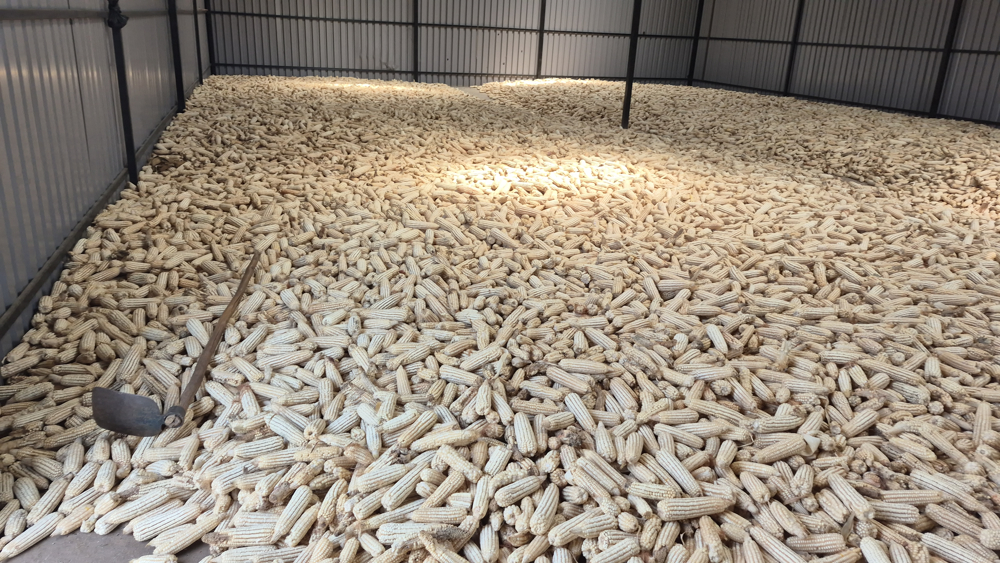 This season's maize drying in the farm's storage barn.